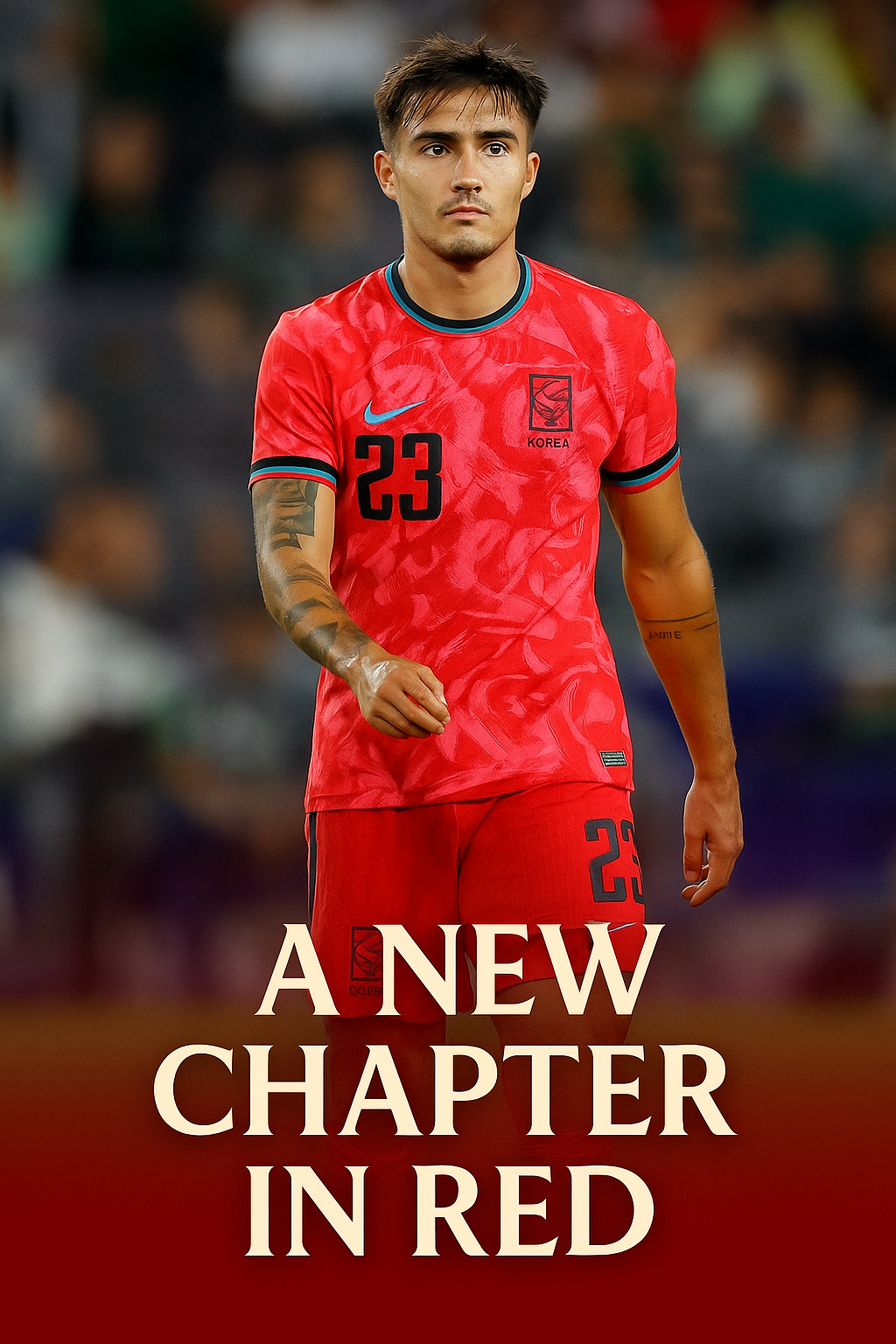
When a footballer steps onto the field, he carries more than boots and jersey. He carries history, expectation, and sometimes the burden of identity itself.
Recently, Korea witnessed such a moment. Christopher Antwi-Adjei Castrop, a young player of mixed heritage, stood with the national team, hand on heart, and sang the Korean anthem before his debut. It was a scene so ordinary in form—athletes line up, music plays—yet extraordinary in meaning. His mother, watching from the stands, wept as if the anthem were not just a melody but proof that her son belonged.
In this brief gesture, one could glimpse the shifting face of Korean society. For decades, Korea was imagined as ethnically uniform, a single story written across generations. Yet global migrations, marriages, and opportunities have rewritten the margins of that story. Castrop, born of two cultures, is not an exception but a herald of what is to come.
His debut performance only magnified the symbolism. Not only did he sing, he played with a poise and energy that electrified both teammates and fans. Social networks buzzed with clips of him sprinting, defending, and celebrating. But behind every tackle and pass lay something deeper: the reconciliation of belonging and difference.
Sport has always been a stage where nations act out their ideals. When Korea fields a mixed-heritage player who sings the anthem with pride, it is more than selection—it is acceptance. His presence whispers that identity is not a cage of bloodlines but a living choice of commitment.
Of course, such symbolism does not erase difficulty. Castrop has faced questions: “Is he Korean enough? Will fans accept him when the excitement fades?” These doubts are not unique to Korea. France, England, Germany—all have wrestled with what it means for a nation’s pride to be carried by those who straddle cultures. But every anthem sung and every goal scored chips away at the hesitation.
For his mother, tears were a natural response to years of uncertainty: Would her child ever be fully recognized in the land she called home? That night, at least for a few minutes, the answer was yes.
The lesson here is subtle but profound. Nations evolve not in proclamations but in lived gestures: a handshake, a cheer, a song sung in earnest. Castrop’s anthem was one such gesture. In it, one hears the future—still contested, still fragile, but undeniably here.
In football, as in life, belonging is not given. It is chosen, affirmed, and lived. And as long as players like Castrop run under the Korean sun, the nation’s story will continue to expand—richer, more diverse, and more human.
#KoreanFootball #Castrop #NationalAnthem #Identity #SportsStory #FootballDebut #DiversityInSports #KCulture


