Date: September 16, 2025
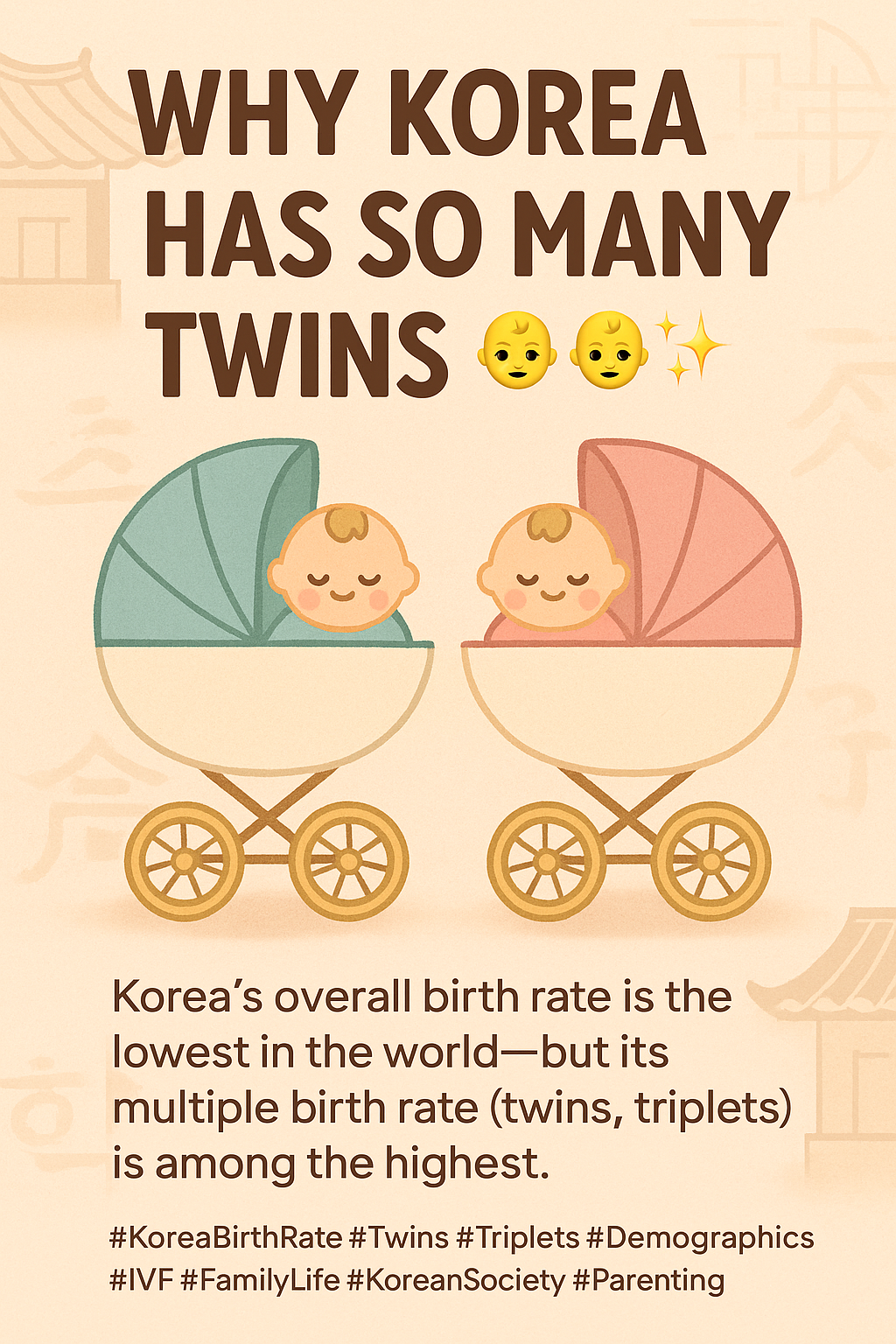
In a nation where declining birth rates dominate headlines, there is one curious statistic that stands apart: South Korea consistently ranks near the top in the world for multiple births. Twins, triplets, and even higher-order births appear in Korean maternity wards with a frequency that seems paradoxical in the context of its broader demographic decline.
The numbers tell a striking story. While overall fertility has plummeted to 0.72 children per woman—the lowest among OECD nations—South Korea’s multiple birth rate has risen. This increase is closely tied to advances in fertility treatments, including in vitro fertilization (IVF) and related technologies, which often implant multiple embryos to increase the chances of pregnancy.
At first glance, this might seem like a silver lining: fewer births overall, but more children at once. Yet beneath the surface lies a more complex truth. Multiple pregnancies carry higher medical risks, both for mothers and infants. Premature births, low birth weights, and long-term developmental concerns are far more common in such cases. For the mothers, the physical and emotional burden grows exponentially with each additional infant.
And so we confront a paradox. In a society desperately seeking solutions to its population crisis, fertility treatments have created a scenario where more babies arrive at once—sometimes at significant cost. Doctors and policymakers face a dilemma: how to balance the medical risks of multiple births with the urgent demand for higher fertility.
Korean society, too, must reckon with this reality. Parenting twins or triplets places extraordinary demands on families—financial, emotional, and social. From the price of diapers and formula to the challenge of finding childcare, the strain can be immense. In some cases, government subsidies help, but rarely enough to meet the unique challenges of raising multiple infants.
Globally, South Korea’s case offers a window into the unintended consequences of medical intervention in demographic policy. Fertility treatments were designed to help individuals realize the dream of parenthood. Yet on a collective level, they have reshaped population dynamics in unexpected ways.
Perhaps the lesson is not only about technology, but about perspective. Children cannot be measured solely in numbers. Behind each statistic lies a story of parents navigating joy, exhaustion, and sacrifice. To treat multiple births as a demographic tool is to risk forgetting that each life, whether one or three at a time, carries infinite value.
South Korea’s high multiple birth rate is not a solution to its demographic crisis—it is a symptom of it. And if society is to address the underlying issue, it must go beyond medicine and subsidies to reimagine what it means to support families, not just count children.
#KoreaBirthRate #Twins #Triplets #Demographics #IVF #FamilyLife #KoreanSociety #Parenting


