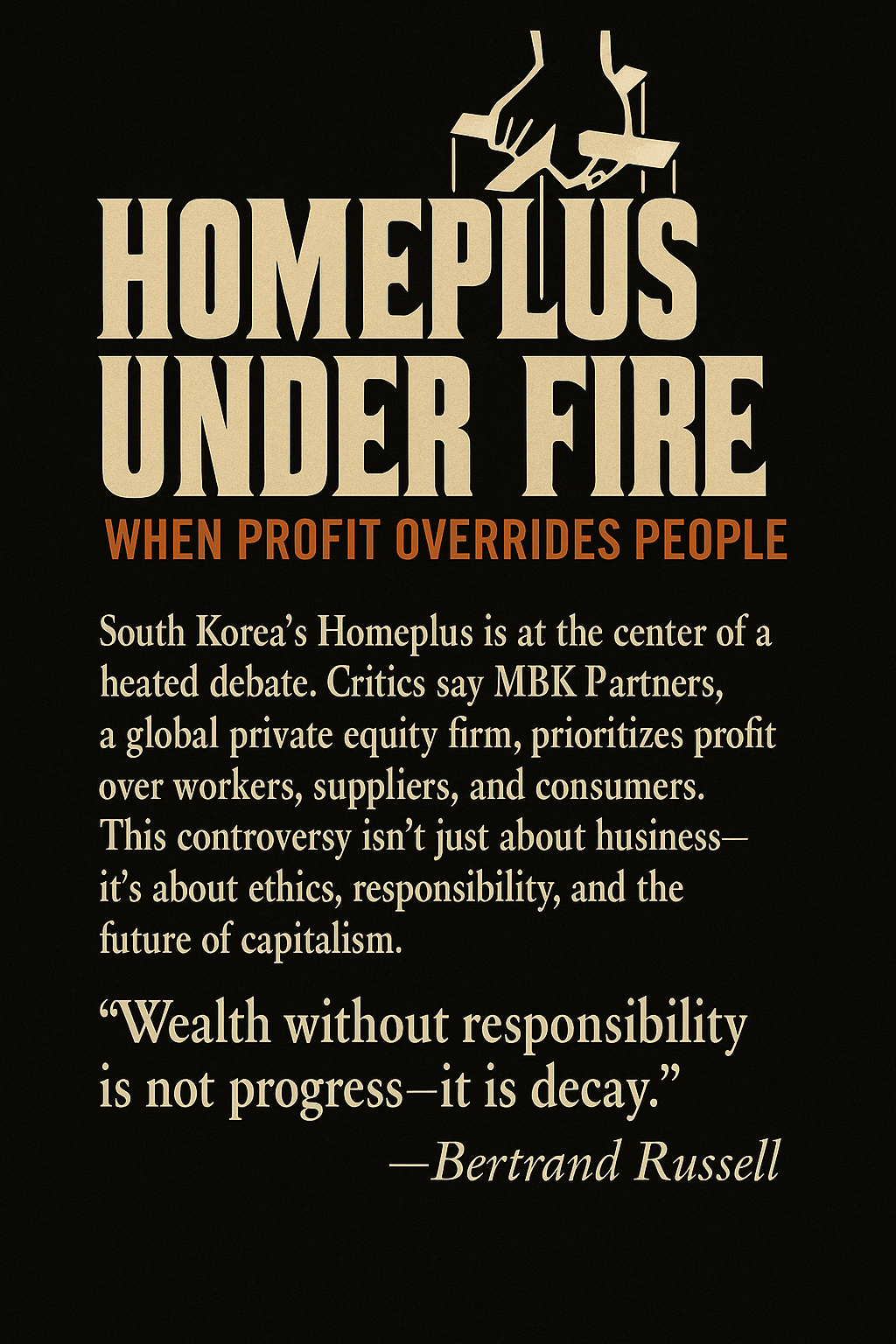
In recent weeks, South Korea has witnessed a heated political and economic debate surrounding the fate of Homeplus, one of the country’s largest supermarket chains. At the center of this storm is MBK Partners, a foreign private equity firm that acquired Homeplus years ago and now stands accused of prioritizing profit extraction over the well-being of workers, partner companies, and consumers. The controversy has not only sparked parliamentary hearings but also raised deeper philosophical questions about ownership, responsibility, and the social fabric of modern capitalism.
---
A Political Firestorm
During the recent confirmation hearings for the candidate to lead the Fair Trade Commission, lawmakers from both ruling and opposition parties converged on one issue: the Homeplus affair must not be ignored. Legislators questioned MBK Partners’ track record, citing concerns about the alleged “strip and flip” strategy often associated with private equity funds.
Representative Min Byung-deok of the Democratic Party argued that unless a parliamentary hearing is convened soon, MBK may proceed with what critics call “predatory” restructuring and asset sales by November. He drew connections to MBK’s ownership of Lotte Card, which recently suffered a hacking incident exposing vulnerabilities in its management. For Min, the pattern was clear: foreign private equity owners reap financial benefits while passing risks and burdens onto local stakeholders.
The ruling People Power Party echoed these concerns. Representative Kang Min-guk acknowledged that “various social problems are emerging” and signaled willingness to cooperate on investigating the issue. This bipartisan stance is rare in Korea’s often polarized politics, suggesting the gravity of the Homeplus case.
---
Beyond Numbers: The Human Cost
At its core, the debate is not only about financial transactions. It is about people: employees worried about job security, small suppliers fearing contract cancellations, and consumers who may face reduced quality or higher prices.
Critics argue that private equity firms like MBK approach companies primarily as financial assets to be optimized for returns. That often means selling off valuable properties, restructuring business lines, and reducing labor costs. While such practices may satisfy investors in the short term, they can weaken long-term competitiveness and devastate local communities.
A labor representative put it bluntly: “This case shows how irresponsible global capital can be, shifting the burden onto workers and society while claiming efficiency.”
---
A Philosophical Lens: Russell and the Ethics of Ownership
The British philosopher Bertrand Russell once observed that the pursuit of wealth, when divorced from social responsibility, can corrode the foundations of civilization. He argued that freedom and prosperity must rest on a balance: individuals and corporations may seek profit, but they must also remain accountable to the broader community that sustains them.
The Homeplus–MBK controversy illustrates this tension vividly. Private equity firms operate globally, driven by financial algorithms and investor expectations. Yet the consequences of their decisions are borne locally, by workers who lose jobs, small businesses pushed to the edge, and consumers whose trust erodes.
Russell would likely ask: What is the purpose of an economy? If it is merely to maximize returns for distant shareholders, then society risks becoming a machine where human dignity is sacrificed for efficiency. But if the economy is to serve human flourishing, then ownership must carry ethical obligations, not just legal rights.
---
Systemic Lessons
South Korea is not alone in facing these dilemmas. Across the world, governments are grappling with how to regulate private equity without stifling investment. The challenge is to strike a balance between encouraging global capital flows and protecting national economic stability.
The Homeplus case highlights several systemic issues:
1. Transparency: Deals involving essential consumer companies must be subject to stricter oversight, ensuring that financial strategies do not undermine public welfare.
2. Labor Rights: Workers should not be treated as disposable costs. Policies must guarantee that restructuring does not arbitrarily destroy livelihoods.
3. Consumer Protection: When ownership changes hands, consumers must be shielded from declining service quality or price exploitation.
4. Political Responsibility: Lawmakers must act decisively, not just issue statements. Failure to regulate now risks setting a precedent that repeats across industries.
---
Toward a More Responsible Capitalism
The Homeplus–MBK controversy is not merely a Korean story. It is part of a global debate about the role of finance in society. Should capital be a servant to human needs, or should humans be servants to capital’s demands?
Bertrand Russell once warned against the tyranny of systems that treat human beings as mere cogs. His words resonate today: unless capitalism evolves to include accountability and compassion, it risks undermining the very societies that sustain it.
In the end, the question is not whether MBK Partners made a profitable investment. The real question is whether their stewardship has honored the responsibilities that come with ownership. If not, then society must reconsider how much power to grant to financial entities that answer to no one but their investors.
---
Conclusion
As the South Korean parliament deliberates on hearings and oversight measures, the Homeplus case offers a critical opportunity. It is a chance to rethink the relationship between global capital and local lives, between financial logic and social justice.
For workers, consumers, and small businesses, the stakes are immediate and personal. For policymakers, the challenge is structural. And for philosophers like Russell, the lesson is timeless: wealth divorced from responsibility is not progress—it is decay.
#Homeplus #MBKPartners #SouthKoreaEconomy #PrivateEquity #CorporateGovernance #LaborRights #ConsumerProtection #BusinessEthics #BertrandRussell #ResponsibleCapitalism


