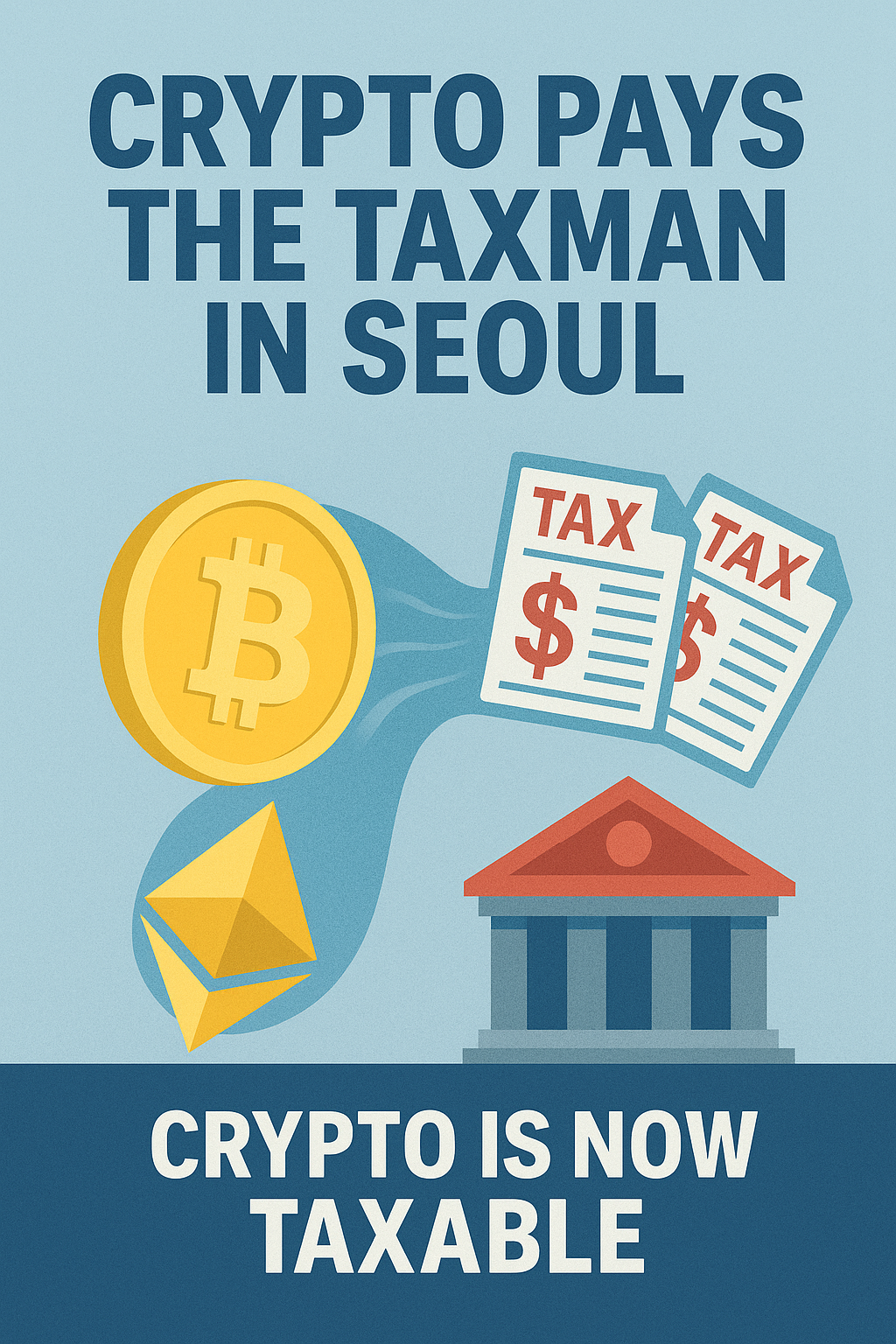
For years, cryptocurrencies have been described as assets that live beyond the grasp of traditional institutions. They were praised as “stateless money,” immune from government intrusion, unbound by the heavy hand of regulators or tax collectors. Yet in September 2025, in the heart of Seoul, that myth quietly began to dissolve.
The district office of Seodaemun, one of the capital’s 25 local jurisdictions, announced that it had seized and sold digital assets from delinquent taxpayers. This was not the first seizure of its kind in Korea, but it was the first time that authorities liquidated such assets directly through domestic exchanges. What had once been considered a hidden sanctuary of wealth suddenly became just another taxable resource, no different in practice from a car, a savings account, or a piece of real estate.
This case is less about technology and more about philosophy. To seize is to assert authority; to liquidate is to close the circle of legitimacy. Until now, bureaucratic friction often meant that seized coins languished in wallets, their value fluctuating while governments debated the procedures. Seodaemun’s decision to open official accounts at Upbit, Bithumb, and Coinone ended that paralysis. For the first time, coins could be moved, sold, and transformed into usable tax revenue. The state, through the smallest unit of its machinery—a district office—declared its competence in the digital economy.
One might ask: what does this mean for ordinary citizens? It means that crypto holdings are no longer an escape hatch. Just as unpaid taxes can result in a lien on your home, they can now be settled through your Bitcoin wallet. The veil of blockchain anonymity, once thought impenetrable, has been pierced by administrative persistence.
The implications extend beyond taxation. At stake is the question of legitimacy. When the government begins to treat digital tokens as enforceable assets, they gain a paradoxical status: they are both speculative and institutional, both risky and recognized. They move from the periphery of finance into its bloodstream.
It is easy to focus on the technical efficiency of the policy—the streamlined manual, the reduced volatility risk, the faster collection of overdue payments. But the deeper meaning lies in what it reveals about the evolution of governance itself. The state adapts not by denying the existence of new technologies, but by incorporating them into its own logic of order and fairness. Seodaemun’s mayor put it plainly: loyal taxpayers should not feel disadvantaged compared to those attempting to hide behind digital wallets. In this simple sentence lies the moral claim—equality before the law, even in the realm of cryptographic money.
Of course, this is only a beginning. Other districts may follow, or they may hesitate. Investors may accept the change, or they may resist. The volatility of crypto markets ensures that liquidation will always carry some risk. But the symbolic frontier has been crossed. Crypto, once imagined as untouchable, is now subject to the mundane routines of governance.
The story resonates with a broader global shift. In the United States, the IRS requires exchanges to issue detailed transaction reports. In Europe, new regulations compel platforms to share user data with tax authorities. Korea’s step may be modest, but it echoes the same trajectory: the integration of crypto into the frameworks of accountability.
For investors, there is both caution and comfort in this development. The caution lies in recognizing that digital assets are no longer beyond oversight; the comfort lies in knowing that legitimacy, however imperfect, reduces the shadow of lawlessness. In the long run, a market bound by rules may prove more durable than one built solely on speculation.
The lesson, then, is that the story of money repeats itself. Gold, paper, and now crypto: each begins as a rebellion against authority, and each eventually finds itself drawn back into the orbit of institutions. Seodaemun’s liquidation of seized crypto is not the end of that story, but it is a telling chapter. It shows us that even in the digital age, the promise of freedom from governance remains an illusion—and that the obligations of citizenship, including taxes, will always find a way to be enforced.
#CryptoTax #BlockchainPolicy #SouthKorea #DigitalAssets #CryptoRegulation
#TaxEnforcement #Bitcoin #Ethereum #CryptoNews #FutureOfFinance


